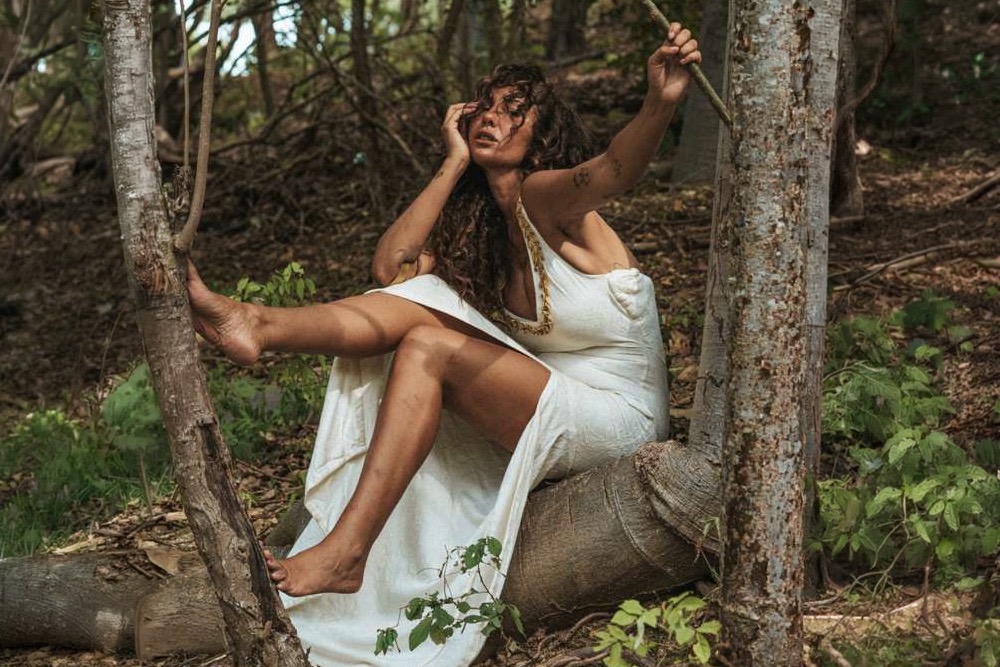
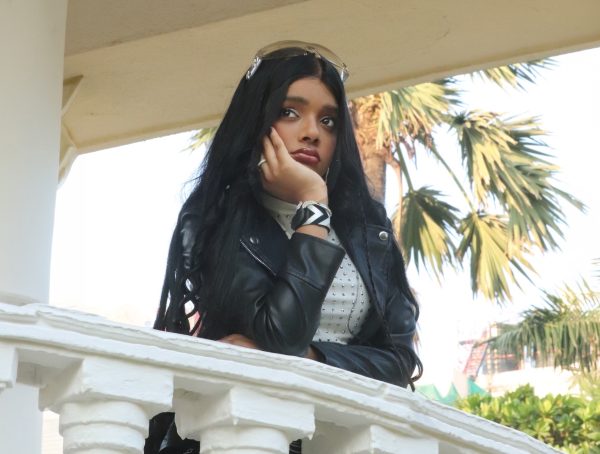
Photo Credit: @corinne.rice.visuals
For seven seasons of Orange Is the New Black, audiences knew her as Marisol “Flaca” Gonzales, the Litchfield inmate with the drawn-on teardrops and the Smiths obsession. It was a role she spent fifteen years chasing before she landed it, and it made her one of the most recognizable Dominican-American faces on television. On August 14, she retires the name that came with it. The single is called “Jacque La Femme,” and from here forward, so is she.
The name is not a marketing exercise. It is the entire premise of the record. “It feels like both a goodbye and an introduction,” Cruz says. “It’s my goodbye to Jackie Cruz as people have always known me, the actress, and my introduction to Jacque La Femme, the musician I’ve always been at heart.”
The claim survives scrutiny, which is more than most reinventions manage. Cruz has been making music the entire time she has been acting. She released her debut album Hija de Chavez in 2019, writing and producing it independently. “La Hora Loca,” from that record, sits just under a million streams on Spotify. That same year Billboard handed her an exclusive premiere for “Lucía Ocho,” her collaboration with Nina Sky, and framed it as the boldest move of her music career to date. She followed it with “Be Bad,” “Cielito Lindo, Capítulo 1,” and “Fruta.” None of it was a side project. It was simply happening in the shadow of a Netflix series that reached a hundred million homes.
What is different now is the room she is making it in. “Jacque La Femme” was written by Cruz and produced by Cruz alongside Diego Contento, a Grammy and Latin Grammy nominated producer signed to Warner Chappell as both a writer and a producer. Contento produced and co-wrote Pedro Capó’s La Neta, which earned Grammy and Latin Grammy nominations, and contributed production to Carlos Vives’ Cumbiana II, winner of Best Contemporary Tropical Album at the 2022 Latin Grammys. His credit list runs through Maná, Gilberto Santa Rosa, Lali Espósito, and Monsieur Periné. An independent artist without a label does not typically get that phone answered.
The making of it was considerably less glamorous than the credits suggest. Cruz lives in the Mexican jungle now, without a car. Getting to the studio is a small expedition every time. “Sometimes I’m on a motorcycle, sometimes a pasajera, sometimes I’m walking up a hill in the heat,” she says. She arrives with the song already written and composed, records her vocals there, explains the feeling she is after, and sends everything to Contento. “In a strange way, these songs took my whole life to write, but once I was ready, they came easily because they were coming from something real.”
What she was waiting to be ready for was softness. “After everything I’ve lived through, becoming a mother helped me reconnect with my femininity, my softness, my intuition, and the woman I was underneath all the survival,” she says. “It’s about realizing that softness isn’t weakness. It can be powerful, sensual, joyful, and free.”
The lyrics are more literal than the sound lets on. Cruz spent years, she says, putting on makeup and eyeliner and lashes that did not even fit her eyes, chasing an idea of beauty that was never hers. Pregnancy was the first time she remembers feeling beautiful. She stopped straightening her hair, stopped covering her skin, and found that letting her body breathe taught her how to breathe.
Then there is the line “God cut my wings, but I still fly.” That one goes back to the car accident that nearly killed her at sixteen. She was left in a coma. She needed brain surgery and treatment for a collapsed lung. Her hair was gone, part of her face was paralyzed, and she had to learn to look at herself again from scratch. It is the story she has told publicly for a decade, but never quite like this. “My hair grew back. I learned to smile again. I survived,” she says. “God gave me something much greater than the beauty I thought I had lost. He gave me my life back.”
None of that weight is audible on first listen. “Jacque La Femme” is light, danceable, and unapologetically sexy, which appears to be the joke she is making. The record sounds like freedom because it took her forty years to earn it.
She is releasing it with no label behind her, roughly 1.5 million followers on Instagram, and nearly 400,000 on TikTok. For an artist who spent her career being told what to sing and how to sound, that arrangement is the point.
Follow Jacque La Femme on Spotify and Instagram.
You might also like
More from Editorial Picks
Chloe Sarah’s “Hate To Say Goodbye” Video Passes 15,000 Views
Fifteen thousand views in a single month is a real number for an independent artist, the kind that does not …

347Smoke Brings Raw Bronx Energy to Hip-Hop With an Unfiltered Vision
Hailing from the Bronx, New York, 347Smoke is an artist who proudly represents the roots of authentic hip-hop while carving …

Erie Ave: Architecting a Legacy at the Crossroads of Street and Boardroom
In an era of fleeting viral moments, Maryland's Erie Ave is constructing something more permanent. The artist operates with a …